
What's the issue with men who carry a bag? It seems that outside major fashion capitals, a man with a bag is perceived as emasculated. And I’m not talking about messenger bags. Those are apparently obeying the rules of the stereotyped masculinity. I personally own a black leather weekender by Rudsak and each time I walk around the city, people stare at me like I’m some sort of alien. Even my friends refer to it as a purse. Not so long ago I was reading this amazing post by Garance Doré on the frustration of being fashionable and stylish when living outside of a fashion capital. The long time Parisian citizen was asking herself if the reality of her teenage years was still going strong in provincial towns. Based on my own experience, I would answer yes. And I would add that the phenomenon is worst when it comes to men. I live in a town with two types of men. The pointy leather shoes/pink tie/purple shirt/black & white-stripped pants type and the cargo pants/rock band t-shirt/cap/skater shoes type. Should I try to fit in the mould? Or should I walk with my head high when carrying my oversized leather bag? Or should I avoid asking myself these questions. Anyway, I’m tired of explaining to everybody that there is an elsewhere, a place where men with bags are not stared at like surreal personas. Very soon, I’ll fill my bag with all I have and escape this clusterfuck.
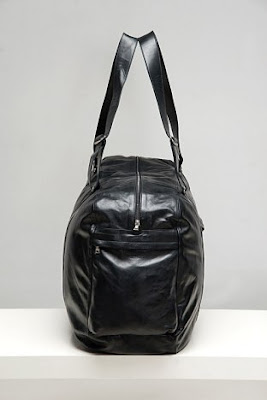
Rudsak
All rights reserved
- © -

Our Legacy – Oxford blue shirt
I went to Rooney, my favourite shop in Montreal, and I just bought the most perfect shirt one could wear. First, if you’re a gentleman (or a British school boy), oxford blue is an essential colour to have in your closet. It’s subtle, classic, and anyway, basic colours on high-quality fabrics are the foundations of a great wardrobe. Second, this shirt is lavish (and the fabric feels so nice). When I wear it, I feel invincible. The shape fits perfectly, some buttons are elegantly placed around the collar and the back pleat is inverted. I get comments on these clever details each time I wear it.
I love this shirt so much that I thought of adopting a radical and systematic style, so that I could wear it every single day. This style would be composed of A.P.C New Standard Jeans with rolled cuffs, a navy blue wool sweater, Rachel Comey’s Uncle Dan shoes and, of course, the Our Legacy oxford blue shirt.
If models wear only black all the time, I shouldn’t feel afraid to try the experiment. What do you think?
Are you magazine obsessed? Are you art-driven? If you’re aware that there’s a gap between Visionaire and Chatelaine, that a magazine is sometime an object of analysis that contains the imaged substance of an avant-garde world. If you’re aware that a magazine may be an embryo of the future advancements in our way to create and to make images, then CV83 is a must. This issue of Ciel Variable is largely dedicated to the influence of both art and artists on the visual aspect of magazines. From auto reflexive creations to artistic post-interventions, the mingling between art and magazines creates the most extensive source of artistic expression of our century. With this in mind, art historians and people in general are more than welcome to see what’s beyond the glossy paper.
With artworks by Hans-Peter Feldman, Christian Boltanski, Michael Snow, Ron Terada and essays by Adam Carr, Zoë Tousignant and others.
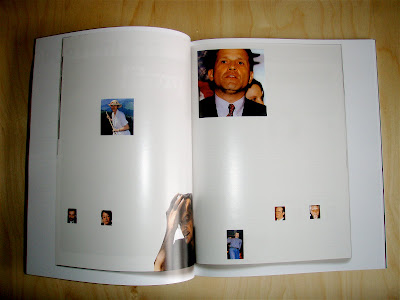
Hans-Peter Feldman

Hans-Peter Feldman
 La sécularisation des sociétés occidentales, fruit d’un processus social qui repoussera la sphère religieuse jusqu’aux confins de l’existence privée, de l’individu, a limité l’expression d’une certaine religiosité dans l’espace commun. Nul doute que notre monde laïcisé s’est constitué sur le rejet de la transcendance d’un ordre religieux dans ses institutions, au profit d’un rapport au monde basé sur l’individu. Parallèlement, l’instigation des valeurs humanistes, des droits de l’homme et de l’égalité en réels systèmes régissant l’organisation sociale ainsi que l’échec des grandes idéologies politiques ont confiné le domaine de la croyance à un réceptacle miniaturisé. Cette conjoncture a permis à l’art contemporain d’investir le domaine de la religiosité et du sacré, d’une manière jusqu’alors inconnue de la sphère artistique. L’art, dans un contexte où les dieux du passé ont disparu, a réussi à «fonder une démarche artistique sur le sacré[1]». Parce que si la société moderne s’est séparée de son assujettissement par la religion, elle «ne s’est pas libérée d’un besoin de religiosité ni d’une conception transcendantale de l’art[2]». La sacralisation de l’art contemporain est accompagnée d’une multitude de caractéristiques propres au domaine de la religion, dont notamment, les reliques. Comment est-il possible d’interpréter cette réminiscence des reliques en art, dernière apologie des incidences d’une sacralité propre à l’esthétique de l’art contemporain? Bref, de quelle manière ce retournement esthétique s’est-il opéré?

Being a high-end shoemaker is not the only peculiarity of Olga Berluti. Heir to a century-old tradition of making perfect hand-made shoes for the top-tier, she is world-renown for her sophisticated yet authentic tastes. In a time of instability, this unique woman embodies quality, prosperity and sustainability. She's perfectly in tune with the reassuring concept of timelessness. And above all? She's the most discreet woman of the fashion industry. A refreshing counterbalance to a world filled with utterly self-centered egos.
 La narrativité en art contemporain sous l’angle des récits antimoraux. L’antimoral ne réfère pas à une conception moralisatrice des thèmes et ne se veut pas une critique des narrations mises en image dans la photographie de mode. Il ne s’agit pas ici de juger ce qui est moral de ce qui est amoral, mais bien de circonscrire une tendance à utiliser des scénarios basés sur la violence, la coercition, la maladie mentale, la dépendance, l’abus et l’horreur.
Une mise en contexte sur le zeitgeist de notre époque, qui dans le champ des arts visuels inclut une propension pour les sujets abjects, est essentielle pour comprendre l’environnement créatif dans lequel les récits antimoraux émergent. Une trame permet de voir le glissement entre la suggestion d’un récit à connotations violentes vers la monstration simple de l’horreur. Évidemment, la logique commerciale de la mode ne pouvant être inconsidérée, l’image de mode réussi à combiner deux apparentes contradictions, le récit antimoral et l’objet à beauté commerciale. Mais quel est l’impact de ces nouvelles manières de présenter la mode sur la construction du féminin?
Copyright
all the texts on this SITE Ⓒ 2009 Zeitgeber & meme. ALL OF THE texts HEREIN, UNLESS OTHERWISE NOTED, ARE COPYRIGHTED. NO text OF THIS SITE MAY BE USED OR REPRODUCED IN ANY MANNER WHATSOEVER WITHOUT EXPRESS PERMISSION OF THE COPYRIGHT HOLDER(S).


 Posts
Posts

